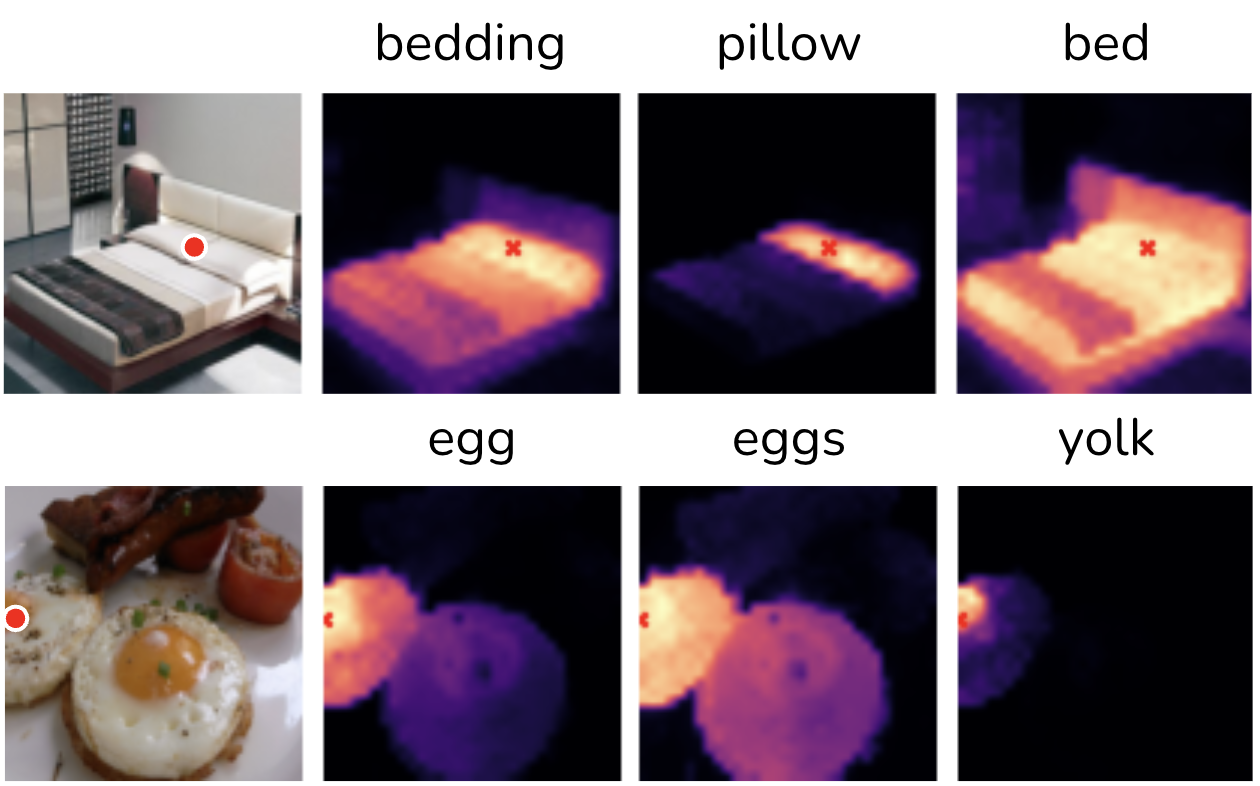
T-REN is a point-prompted vision-language encoder that produces text-aligned region tokens.
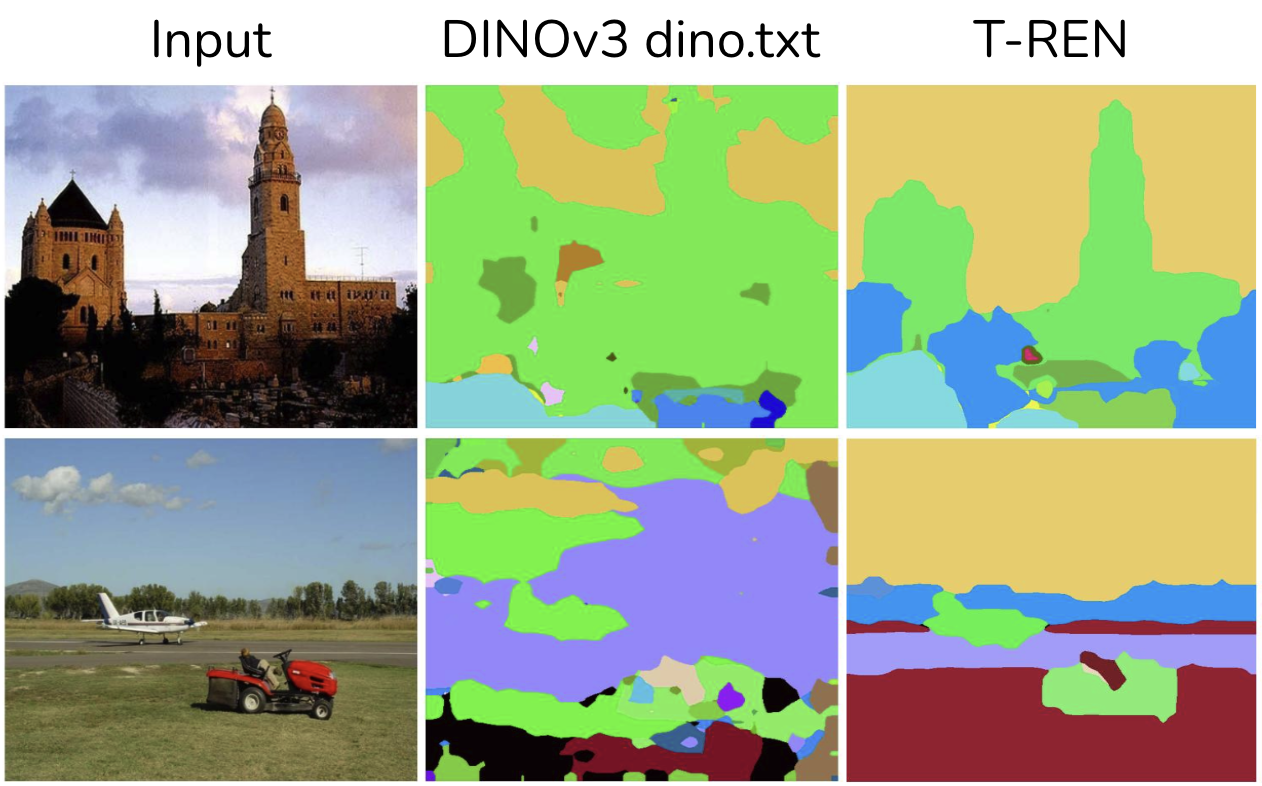
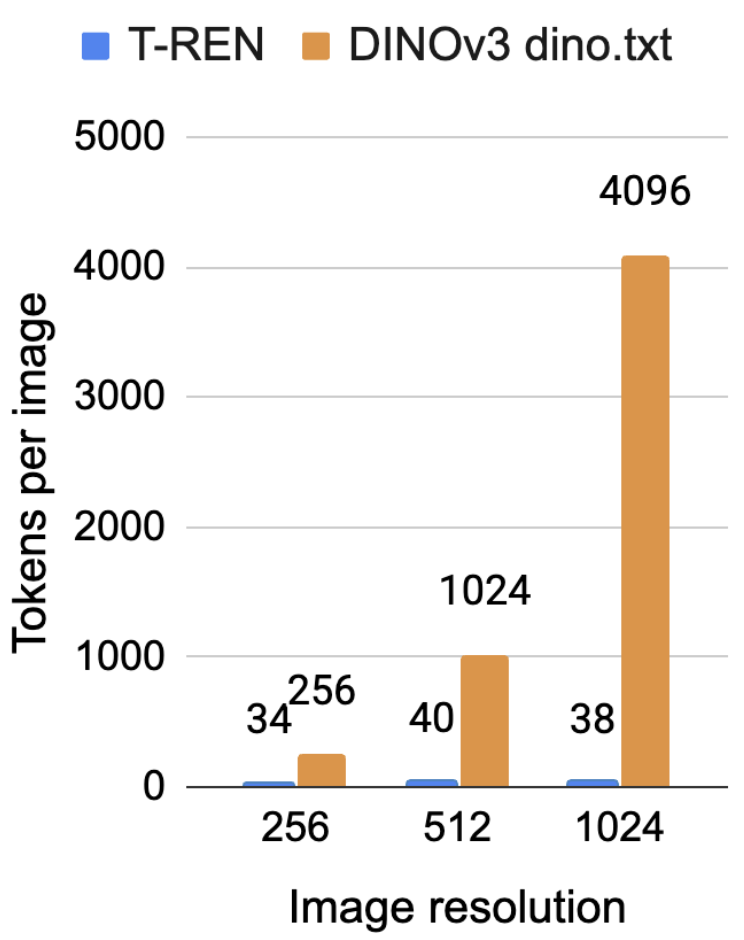
Despite recent progress, vision-language encoders struggle with two core limitations: (1) weak alignment between language and dense vision features, which hurts tasks like open-vocabulary semantic segmentation; and (2) high token counts for fine-grained visual representations, which limits scalability to long videos. We propose T-REN (Text-aligned Region Encoder Network), an efficient encoder that maps visual data to a compact set of text-aligned region-level representations (or region tokens). T-REN adds a lightweight network on top of a frozen vision backbone, trained to pool patch-level representations within each semantic region into region tokens and align them with region-level text annotations. With only 3.7% additional parameters compared to the vision-language backbone, this design yields substantially stronger dense cross-modal understanding while reducing the token count by orders of magnitude. Specifically, T-REN delivers +5.9 mIoU on ADE20K open-vocabulary segmentation, +18.4% recall on COCO object-level text-image retrieval, +15.6% recall on Ego4D video object localization, and +17.6% mIoU on VSPW video scene parsing, all while reducing token counts by more than 24× for images and 187× for videos.
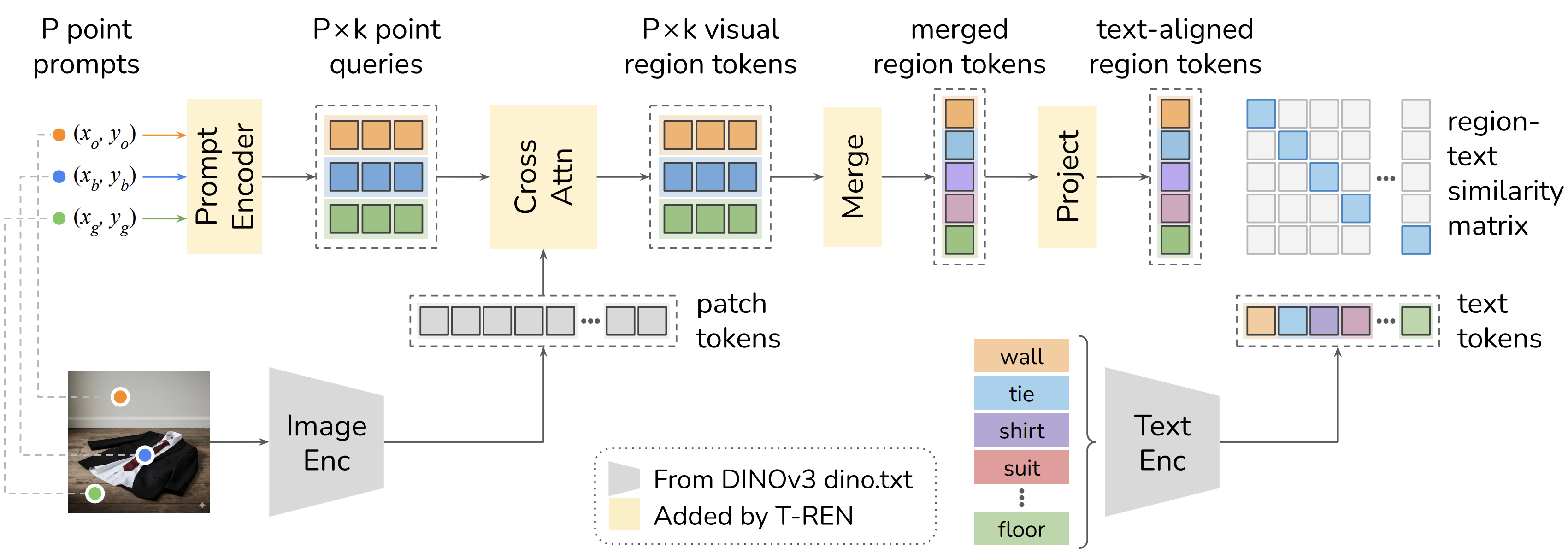
Given an input image and a grid of point prompts, T-REN pools semantically related patch
features via cross-attention to produce k=3 region tokens per point. Multiple
tokens per prompt capture both whole objects and their parts, addressing the part-whole
ambiguity in REN. Highly similar tokens are then merged to reduce redundancy, and the
resulting region tokens are projected into the text embedding space for open-vocabulary
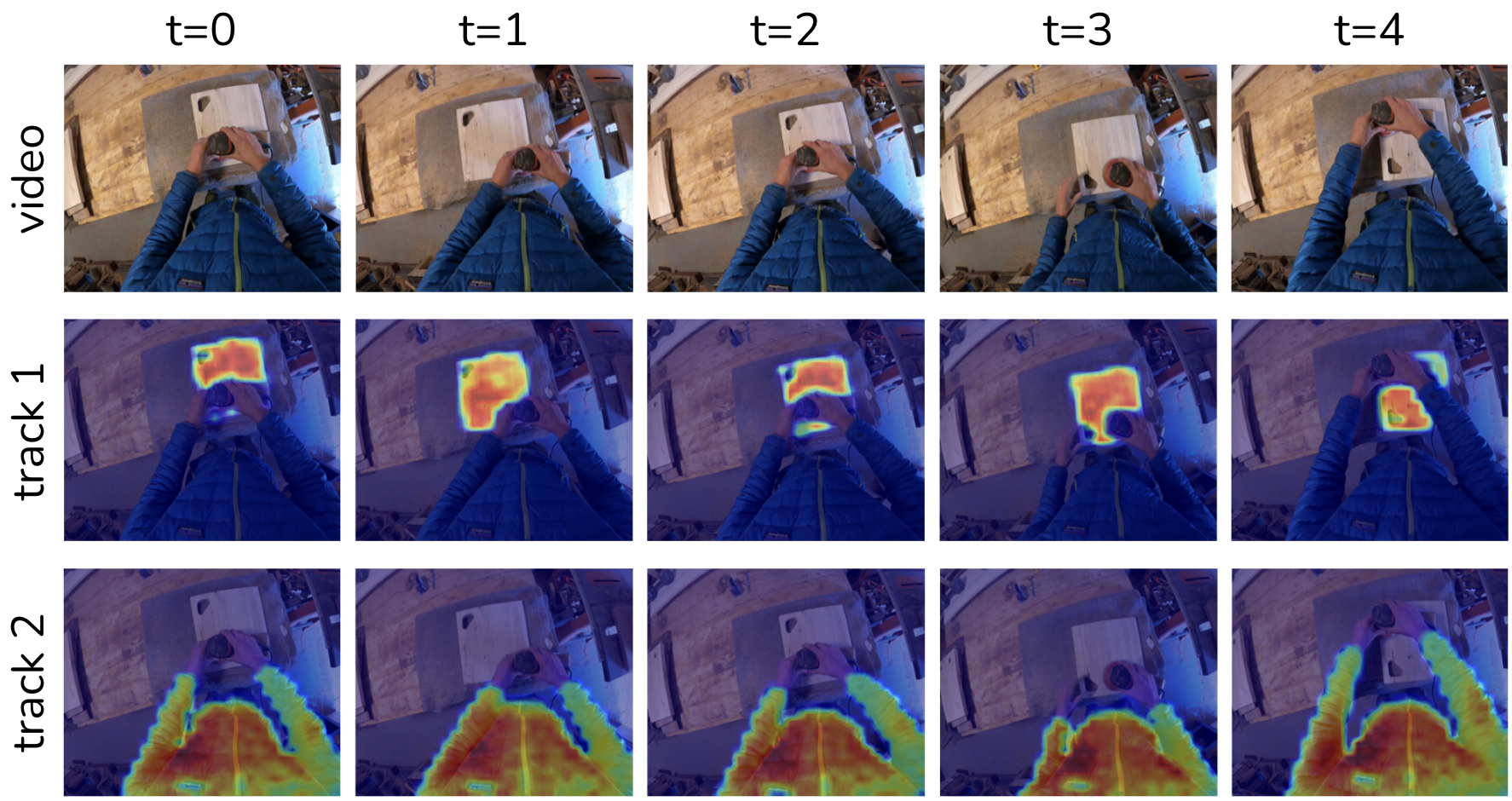
matching. For videos, similar region tokens are aggregated across consecutive frames into
compact track tokens. T-REN is trained with contrastive and distillation objectives that
jointly learn spatial pooling and region-text alignment on a frozen DINOv3-based dino.txt
backbone.
T-REN improves dense vision-language alignment, outperforming both patch-based encoders and SAM-guided methods.
| Method | ADE20K | Cityscapes |
|---|---|---|
| SAM-guided approaches | ||
| Trident | 25.6 | 46.9 |
| RADSeg+ | 29.9 | 45.8 |
| TextRegion | 27.3 | 47.4 |
| Patch-based vision-language encoders | ||
| CLIP | 6.0 | 11.5 |
| EVA-02-CLIP | 10.9 | 14.1 |
| SigLIP-2 | 10.8 | 16.3 |
| PE | 17.6 | 21.4 |
| DINOv2 dino.txt | 19.2 | 27.4 |
| DINOv3 dino.txt | 24.7 | 36.9 |
| T-REN | 30.6 | 52.7 |
| T-REN+ | 32.0 | 58.7 |
On the Visual Haystacks' single-needle challenge, T-REN outperforms vision-language encoders, open-source LMMs, and RAG-based methods, and is competitive with Gemini-3 Pro while remaining far cheaper than MLLMs. "E" indicates context overflow, execution failure, or API error.
| Method | D=1 | D=2 | D=3 | D=5 | D=10 | D=20 | D=50 | D=100 | D=500 | D=1K |
|---|---|---|---|---|---|---|---|---|---|---|
| Proprietary LMMs | ||||||||||
| Gemini-3 Pro | 88.9 | 89.2 | 87.3 | 87.2 | 85.7 | 83.5 | 74.3 | 74.1 | 71.0 | 67.9 |
| Gemini-1.5 Pro | 88.4 | 82.0 | 78.3 | 76.0 | 71.9 | 68.6 | 62.8 | 57.4 | E | E |
| GPT-4o | 82.5 | 79.9 | 77.5 | 73.3 | 68.2 | 65.4 | 59.7 | 55.3 | E | E |
| Open-source LMMs | ||||||||||
| LongVILA | 63.8 | 59.0 | 57.7 | 56.7 | 55.6 | 52.0 | 52.0 | 52.0 | E | E |
| Qwen2-VL | 80.9 | 76.6 | 73.6 | 67.9 | 62.6 | 59.1 | 52.6 | E | E | E |
| Phi-3 | 80.5 | 69.1 | 67.3 | 62.0 | 54.8 | 52.6 | 50.8 | E | E | E |
| InternVL2 | 88.1 | 80.5 | 72.3 | 63.9 | 58.8 | 55.2 | E | E | E | E |
| mPLUG-OWL3 | 84.4 | 66.0 | 62.1 | 57.0 | 53.2 | 51.5 | E | E | E | E |
| Retrieval-Augmented Methods | ||||||||||
| LLaVA-v1.5 | 85.8 | 77.1 | 75.8 | 68.6 | 63.6 | 60.4 | 55.3 | 57.5 | 55.4 | 52.9 |
| MIRAGE | 83.2 | 77.8 | 76.6 | 72.8 | 70.5 | 66.0 | 63.6 | 62.0 | 58.7 | 55.7 |
| Vision-Language Encoders | ||||||||||
| SigLIP-2 | 72.0 | 69.2 | 68.1 | 65.3 | 64.1 | 60.3 | 58.7 | 58.3 | 56.6 | 54.9 |
| REN | 81.2 | 78.6 | 77.4 | 76.0 | 74.0 | 72.1 | 68.3 | 65.5 | 62.3 | 59.2 |
| DINOv3 dino.txt | 72.7 | 71.3 | 69.2 | 68.2 | 66.1 | 63.2 | 60.9 | 60.2 | 56.4 | 52.1 |
| T-REN | 88.5 | 86.4 | 85.3 | 83.9 | 82.6 | 79.6 | 75.2 | 74.0 | 68.2 | 65.2 |
REN predicts a single region token per point prompt, which cannot resolve part-whole ambiguity. T-REN predicts k=3 tokens per point, and this multi-token setup consistently improves Visual Haystacks accuracy over a single-token T-REN variant.
| Setup | D=2 | D=3 | D=5 | D=10 | D=20 | D=50 |
|---|---|---|---|---|---|---|
| Single token per prompt | 81.3 | 80.3 | 78.1 | 77.1 | 72.4 | 69.6 |
| Multiple tokens per prompt | 86.4 | 85.3 | 83.9 | 82.6 | 79.6 | 75.2 |
Track tokens from T-REN preserve fine-grained spatial information while remaining compact enough for long videos. On Ego4D query localization, T-REN improves recall by 15.6% over DINOv3 dino.txt with 187.5× fewer tokens. On VSPW scene parsing, it improves mIoU by 17.6% with 254.5× compression.
| Method | Query Localization (Ego4D) | Scene Parsing (VSPW) | |||
|---|---|---|---|---|---|
| Recall@1 | tAP | Compression (↑) | mIoU | Compression (↑) | |
| DINOv3 dino.txt | 36.8 | 14.4 | 1× | 20.7 | 1× |
| REN | 39.0 | 19.9 | 26.8× | 18.5 | 22.9× |
| T-REN | 52.4 | 26.4 | 187.5× | 38.3 | 254.5× |
@inproceedings{khosla2026tren,
    title={T-REN: Learning Text-Aligned Region Tokens Improves Dense Vision-Language Alignment and Scalability},
    author={Savya Khosla and Sethuraman T V and Aryan Chadha and Alexander Schwing and Derek Hoiem},
    booktitle={European Conference on Computer Vision (ECCV)},
    year={2026}
}